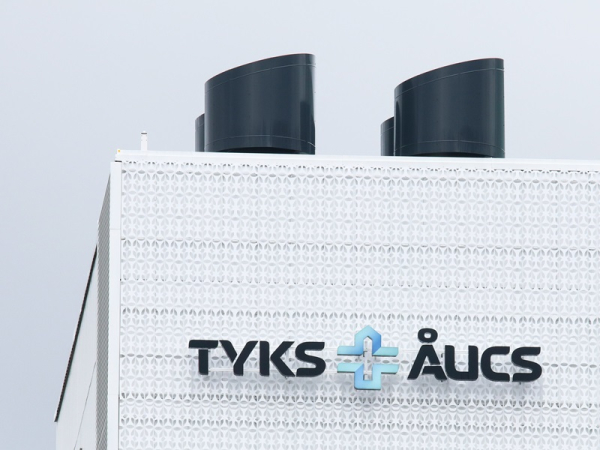


The facade of T Hospital in Turku, Southwest Finland, on 4 July 2024. Varha, the well-being services county in the region, is the latest to resort to consultative negotiations to close its budget deficit. It revealed last week it would be making “significant changes” to the terms of about 220 employees and officials in order to slash costs by 11 million euros. (Laura Ukkonen – Lehtikuva)
- Next Article Earnings-based unemployment allowance to drop noticeably in September
CONSOLIDATIONS are not a silver bullet to the financial woes of well-being services counties in Finland, Mika Kortelainen, a professor of health economics at the University of Turku and research professor at the Finnish Institute for Health and Welfare (THL), estimates in an interview with Helsingin Sanomat.
Debate over means to solidify the financial standing of counties has heated up over the past month or so as the counties have presented revised projections of their budget deficits for this year.
The latest data indicates that the 21 counties are projecting a combined deficit of 1.45 billion euros for this year, representing an almost 600-million-euro jump from projections unveiled late in the spring.
Varha, the well-being services county for Southwest Finland, last week became the latest county to announce consultative negotiations, revealing it is looking to reduce its costs by 11 million euros by making “significant adjustments” to the terms of about 220 employees and officials. Overall the county is scrambling to generate cost savings of 81.5 million euros by 2025.
Both Prime Minister Petteri Orpo (NCP) and Minister of Finance Riikka Purra (PS) conceded last week that the social and health care system is dysfunctional, the latter saying it is “clear as day” that the reform that established the counties was unsuccessful.
Kortelainen on Sunday reminded Helsingin Sanomat that research data provide no clear indication about what would be the optimal number of well-being services counties from an economic perspective.
“It’s wishful thinking to think you could create significant savings by consolidating counties. It might sound as the easiest solution for policy makers,” he said to the daily.
He pointed to mandatory municipal consolidations as evidence that consolidations inevitably create also problems and do not necessarily rationalise decision-making. Establishing fewer counties initially could have been yielded better results, he gauged, but it was not politically feasible.
The possibility of consolidations was brought up recently by Marina Erhola, the chief executive of the county in Pirkanmaa. Erhola on 15 August stated to YLE that the number of counties could be as much as halved.
Orpo on Friday told STT that the government is prepared to consolidate certain counties if the consolidation is deemed necessary for the availability of services and the financial health of the counties. According to Helsingin Sanomat, the government would be likely to carry out the consolidations through the assessment procedure outlined in the government programme, rather than through other methods.
The procedure is a key tool for pressuring the counties to create savings.
While no county has yet to formally trigger the procedure, it is believed that five counties with the largest per-capita budget deficits are under special scrutiny: Central Finland, Eastern Uusimaa, Kanta-Häme, Lapland and Vantaa-Kerava.
Kortelainen viewed that the government should rather tackle a key shortcoming in the funding system – the lack of incentives that guarantee operational efficiency.
“Today, counties receive funding based on their population and morbidity, rather than based on how care has been organised. It should be possible to receive more funding by handling things well. Could you pay more for shorter queues, for example?” he mused.
A more efficient approach to provide such incentives would be to grant counties the right to levy taxes, according to Kortelainen. It would not require a complicated maze of incentives, but would encourage efficiency by making counties responsible for both setting their tax rates and producing the services.
The idea has been rejected by the current ruling coalition. The National Coalition in particular is reluctant to introduce any new taxes in Finland.
Aleksi Teivainen – HT
- Next Article Earnings-based unemployment allowance to drop noticeably in September
Source: www.helsinkitimes.fi
