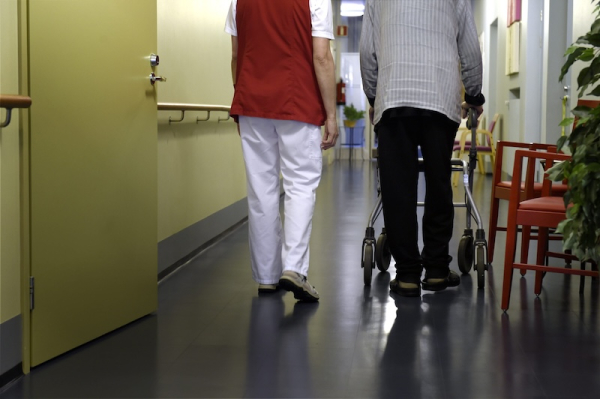


Nurse in Helsinki. LEHTIKUVA
- Next Article Thousands in Helsinki light candles for Ukraine war anniversary
The number of new work permits issued in Finland fell further in 2024, continuing a two-year downward trend, according to the latest Akava Works immigration report.
In 2024, approximately 11,000 new work permits were granted, 4,000 fewer than in 2023 and 5,000 fewer than in 2022. The sharpest decline was in residence permits for workers, which dropped by nearly 4,000. Permits for specialist professionals also fell by around 400.
“The decline in work permits has now continued for two consecutive years,” said Tomi Husa, an expert at Akava. “The biggest drop at the end of 2024 was in permits for healthcare and social services workers. In the last quarter of 2023, 598 permits were granted in this sector. A year later, the number had plummeted to just 17.”
Specialist permits, often issued for highly skilled workers, also fell by 25%. The information and communications technology (ICT) sector remains the largest recipient of work permits but has also seen the steepest decline over the past two years.
“This is not entirely surprising, as unemployment among highly educated professionals in ICT and engineering has risen significantly,” Husa noted. “Naturally, this affects demand for foreign labour. What’s worrying is that in 2024, none of the major specialist sectors saw an increase in permit numbers.”
Akava has called for a major expansion in work- and skills-based immigration, aiming to triple the number of international specialists in Finland.
“The drop in specialist permits in 2024 is a serious concern. We are heading in the wrong direction,” said Maria Löfgren, president of Akava. “One solution we propose is to automatically grant permanent residence to every international graduate who completes a higher education degree in Finland.”
She also emphasised the need to improve work-based language and integration training, ensuring it is available regardless of visa processing timelines.
“We need a long-term policy for work- and skills-based immigration. Concrete actions are needed to create an open, non-discriminatory, and international work environment,” Löfgren added. “This will be critical for Finland’s future economic growth.”
The Akava Works report is based primarily on data from the Finnish Immigration Service, focusing on first-time residence permits. Since these permits are issued to individuals not yet residing in Finland, they provide a key indicator of immigration trends. The report does not cover citizens of EU/EEA countries or Switzerland, who can move to Finland freely without a residence permit.
HT
- Next Article Thousands in Helsinki light candles for Ukraine war anniversary
Source: www.helsinkitimes.fi
