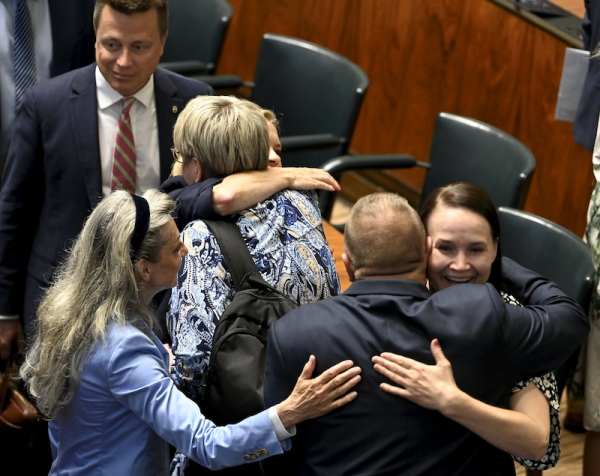


Finns Party MP’s hugged each others after Finland’s Parliament voted on the government’s plans to change the country’s deportation laws at the Parliament House in Helsinki, Finland, on Friday, 12th July, 2024./ Lehtikuva
- Next Article Razmyar urges Social Democrats not to tie members’ hands on border security bill
Finnish lawmakers narrowly approved a controversial bill on Friday that permits border guards to turn away third-country migrants attempting to enter from Russia and reject their asylum applications. This measure, according to Helsinki, is a response to what it calls “hybrid warfare” by Moscow, accusing Russia of deliberately directing undocumented migrants to their shared border.
The law, which introduces temporary measures for one year, was passed with 167 votes in favour, the exact number needed in the 200-seat Eduskunta, or Parliament. The bill faced opposition from the Left Alliance and the Green League, with 31 members voting against it.
Prime Minister Petteri Orpo’s center-right government emphasised the law’s necessity for national security, claiming that Russia’s actions aim to destabilise Finland by pushing migrants to the heavily guarded Russia-Finland border, which also serves as the EU’s northern external border.
Critics, including academics, legal experts, and human rights organisations, argue that the law violates the Finnish Constitution and international commitments to the United Nations and the EU. Michael O’Flaherty, the Council of Europe Commissioner for Human Rights, has expressed concerns that this legislation could set a troubling precedent globally.
Finland closed its 1,340-kilometer (830-mile) land border with Russia last year after an unusual influx of over 1,300 undocumented migrants within three months, following Finland’s accession to NATO. The majority of these migrants came from the Middle East and Africa, including countries such as Afghanistan, Egypt, Iraq, Somalia, Syria, and Yemen.
Under the new law, pending approval from President Alexander Stubb, Finnish border guards can, under specific conditions, refuse migrant asylum applications at crossing points. However, they are required to admit children, disabled people, and any migrants considered to be in particularly vulnerable positions.
Finance Minister Riikka Purra, chair of the nationalist far-right Finns Party, stated that national security must be the top priority, saying, “We cannot allow Russia to exploit weaknesses in our legislation and international agreements.” Despite the controversy, similar measures have been adopted by EU members Poland, Latvia, and Lithuania to manage migrant flows from Belarus.
New Law Explained:
1. Temporary Measure: The law will be in effect for one year.
2. Border Control: Allows border guards to turn away third-country migrants and reject asylum applications at the Russia-Finland border.
3. Exceptions: Children, disabled individuals, and particularly vulnerable migrants will still be accepted.
4. National Security: The law is aimed at countering perceived hybrid warfare tactics by Russia.
5. Training for Border Guards: Guards will receive training to handle new responsibilities, including assessing migrants’ age, health, and vulnerability.
6. Pushbacks: The law permits the rejection of asylum applications at the border, a practice criticised by international and EU laws.
7. Response to Mass Migration: Plans include managing large groups of migrants without the use of violence, with preparations for various scenarios.
8. Humanitarian Concerns: The law includes provisions for emergency humanitarian aid if migrants cannot return to Russia and are stranded in the border area.
Michael O’Flaherty, the Council of Europe Commissioner for Human Rights, had earlier expressed concern about the draft law and urged against its adoption.
“The Commissioner emphasises that the relationship between national security and human rights is not a zero-sum game,” a Council of Europe statement said in June. “The Commissioner also raises concerns that the (Finnish) draft law, if adopted, would set a worrying precedent for other countries and for the global asylum system.”
Finland closed the 1,340-kilometer (830-mile) land border with Russia last year after more than 1,300 migrants without proper documentation or visas — an unusually high number — entered the country in three months, just months after the nation became a member of NATO.
Most of the migrants that arrived in 2023 and early this year hail from the Middle East and Africa, including from Afghanistan, Egypt, Iraq, Somalia, Syria and Yemen.
Under the new law, pending approval from President Alexander Stubb, Finnish border guards can — under certain circumstances — reject migrant asylum applications at the crossing points. They will not, however, refuse entry to children, disabled people and any migrants deemed by border guards to be in a particularly vulnerable position.
Finance Minister Riikka Purra, chair of the nationalist far-right Finns Party that forms the Cabinet’s core together with Orpo’s conservative National Coalition Party, said that nothing can take precedence over maintaining national security.
“We cannot allow Russia to exploit weaknesses in our legislation and international agreements,” Purra said.
Pushbacks — the forcible return of people across an international border without an assessment of their rights to apply for asylum or other protection — violate both international and EU law. However, EU members Poland, Latvia and Lithuania have previously resorted to the controversial measure when dealing with migrants attempting to enter from Belarus.
Latvia, Lithuania and Poland have all introduced laws similar to the one proposed in Finland.
HT
- Next Article Razmyar urges Social Democrats not to tie members’ hands on border security bill
Source: www.helsinkitimes.fi
