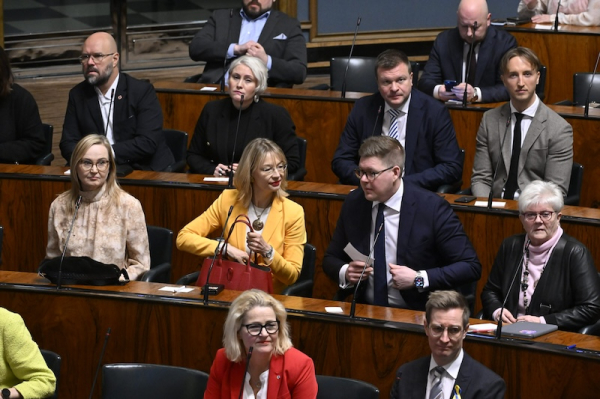


Politicians in a plenary session of Parliament in Helsinki on 4 February 2025. LEHTIKUVA
- Previous Article Finnish Environment Institute updates syke.fi for better access to environmental data
- Next Article Finland ranks second in global corruption index
A majority of Finns (71%) believe politicians should not hold multiple elected positions simultaneously, according to a new EVA Values and Attitudes Survey. The findings suggest strong public support for restricting the ability of politicians to serve at the same time as members of parliament, municipal councillors, and regional councillors.
Of those in favour of restrictions, 33% support a rule allowing only one elected position at a time, while 38% would permit a maximum of two concurrent roles.
Only 22% of respondents support the current system, where politicians can hold multiple mandates simultaneously. Even among them, the majority (18% of all respondents) believe there should be greater transparency in reporting on their various roles.
Swiss economist Natanael Rother, a visiting fellow at EVA, argues that overlapping mandates contribute to Finland’s inability to implement structural reforms. He notes that when municipal councillors are elected to parliament, their accountability to local voters weakens. Access to national budget decisions reduces incentives for fiscal discipline at the local level, and in most cases, holding multiple mandates undermines effective governance.
EVA’s research director Ilkka Haavisto suggests that political parties could impose internal restrictions, preventing members from holding overlapping roles or requiring them to resign from lower-level positions when elected to higher office. Another option would be to synchronise parliamentary, municipal, and regional elections, as is done in Sweden, encouraging politicians to focus on a single level of government. A more complex solution would be a constitutional amendment to restrict eligibility for multiple mandates, though this would require significant legal changes.
Haavisto and Rother conclude that public opinion supports decentralising power rather than concentrating it in the hands of a few individuals. They argue that preventing the accumulation of mandates should be a key political objective.
The survey also reveals divided opinions on the role of regional councils and the necessity of regional elections. Nearly one-third (31%) of Finns believe regional elections are unnecessary and that municipalities should appoint representatives to regional councils without elections. However, 41% support the elections, while 27% remain undecided.
The findings are based on 2,018 responses collected between 8–21 October 2024. The survey, conducted by Taloustutkimus Oy, represents Finland’s 18–79-year-old population, excluding Åland. The margin of error is 2–3 percentage points in either direction. The statistical analysis and graphical representation of the results were conducted by Pentti Kiljunen (Yhdyskuntatutkimus Oy).
HT
- Previous Article Finnish Environment Institute updates syke.fi for better access to environmental data
- Next Article Finland ranks second in global corruption index
Source: www.helsinkitimes.fi
