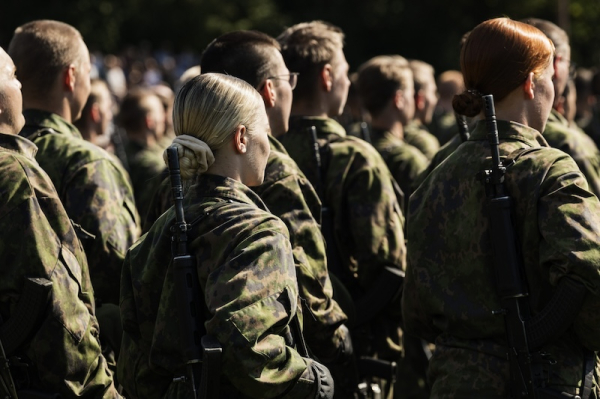


Conscript soldiers of the Guard Jaeger Regiment at a military oath ceremony in Kerava. Photo: Roni Rekomaa / Lehtikuva
- Next Article Stubb speaks with Trump and Zelensky as Finland pushes Ukraine agenda
Seven in ten Finnish women are prepared to defend Finland’s borders and territorial integrity, according to a new national survey.
The study, conducted by E2 Research on behalf of the Women’s Preparedness Association, shows a high level of willingness among women to support the country’s security in times of crisis or conflict. The results were based on a representative sample of women across Finland, gathered in May 2025.
Support for defending Finnish borders was particularly strong among women aged 50–59, with 83 percent expressing readiness. By contrast, only 47 percent of women aged 18–29 shared that view.
The majority of respondents also indicated a willingness to defend human rights and gender equality (61 percent), state sovereignty (57 percent), Finnish welfare (56 percent), and democracy (55 percent).
Among younger women aged 18–29, human rights and democracy were more frequently named as key values worth defending, with 78 percent and 68 percent respectively identifying them as priorities.
Readiness to defend the country extended beyond abstract values. Almost half (44 percent) said they were willing to take part in unarmed defence in the event of an armed attack, while nearly a quarter (23 percent) would be prepared to take up arms. Several respondents referenced the actions of previous generations during wartime as motivation.
“The results confirm what we see in practice: women are willing to participate and contribute to the resilience of society,” said Paula Risikko, Deputy Speaker of Parliament and Chair of the Women’s Preparedness Association.
“Women have diverse skills and are ready to use them for the benefit of the whole society.”
Young women favour civilian and expert roles in crisis situations
A clear majority of women, 71 percent, said they would be willing to assist in practical civilian support roles, such as food distribution, first aid, or temporary accommodation in times of crisis. Around 68 percent said they would help family and neighbours if necessary.
Among younger women aged 18–29, willingness to help was even higher. Seventy-four percent would take part in practical tasks, and 77 percent would support people in their immediate circle. Over half (54 percent) would offer psychosocial support, including care for children or the elderly, and discussion-based assistance.
Young women were also more likely than other age groups to participate in expert-level tasks. These included IT support, teaching, and public communication, especially on social media, during emergency conditions.
The findings suggest that while different age groups prioritise different aspects of national resilience, the overall sense of responsibility and preparedness among women is strong.
Training viewed as key to crisis readiness
Nearly seven out of ten women (69 percent) expressed a willingness to attend training to improve their personal readiness for crisis situations.
In addition, 46 percent were open to training aimed at supporting authorities during emergencies, and one in five women (21 percent) said they would consider training that enhances their ability to assist military defence efforts.
Respondents cited several reasons for their interest in training. Many said they wanted to be able to act rather than rely on others, and that being prepared would help ensure they could contribute effectively if needed.
“It is encouraging that training is seen as meaningful,” said Pia Lindell, Executive Director of the Women’s Preparedness Association. “Citizens’ readiness to act in times of disruption is a vital part of national security.”
She added that the share of women willing to train in support of military defence, 21 percent, exceeds the historical figure for women’s participation in auxiliary wartime roles. In 1944, about 11 percent of adult women served in organisations such as the Lotta Svärd, military canteens or the Finnish Red Cross.
Karina Jutila, Director of E2 Research, said the results show that Finnish women of all ages are committed to defending the core elements of society.
“Borders and sovereignty, democracy, human rights, and wellbeing are widely seen as values worth protecting,” she said.
HT
- Next Article Stubb speaks with Trump and Zelensky as Finland pushes Ukraine agenda
Source: www.helsinkitimes.fi
