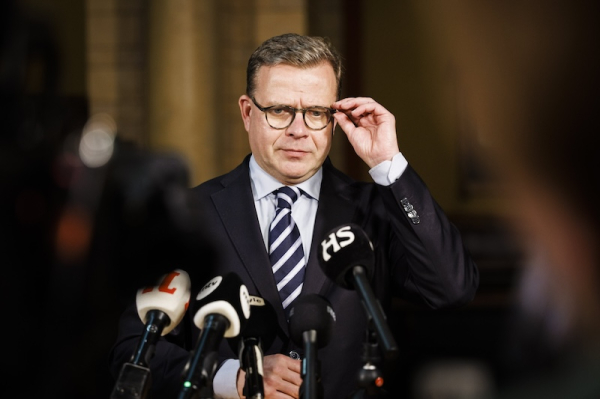


Prime Minister Petteri Orpo (NCP) speaking to the press. Photo: Seppo Samuli / Str / Lehtikuva
- Next Article Police identify three suspects over racist abuse aimed at Finland’s Lucia
Prime Minister Petteri Orpo said Finland’s recent employment statistics were “distressing” but stressed that international factors, not domestic policy, were behind the decline.
Speaking by phone to Yle from New York, where he is attending the UN High-Level Political Forum, Orpo acknowledged that the fall in employment since his government took office in 2023 marked a serious setback.
“There’s no getting around it,” he said. “These employment figures are distressing.”
Figures released this week by Statistics Finland show that 64,000 fewer people are employed compared to the beginning of the government’s term. The unemployment rate now stands at 10.2 percent.
Despite this, Orpo rejected the idea that the government’s economic policy was failing. He pointed to external causes, including uncertainty in the global economy and the impact of trade tensions sparked by US President Donald Trump’s administration.
“These are factors that affect a small, open economy like Finland,” he said. “We must continue to work determinedly to improve our competitiveness and get investments moving.”
Orpo maintained that his government had implemented the right measures to support employment but said results would take time to materialise. He noted that several private sector investments had already been announced, including Fazer’s factory expansion in Lahti and ongoing data centre projects.
He also mentioned a recent rise in the number of open job vacancies as a positive indicator.
“So this situation is not hopeless,” he said. “But the uncertainty must be removed globally. I believe that the economy will start growing after that.”
The government’s official goal is to create 100,000 new jobs by the end of its term in 2027. To reach this, employment would need to increase by 164,000 in under two years.
Asked whether this was realistic, Orpo said he remained confident that the objective could be achieved.
The prime minister declined to comment directly on criticism that government spending cuts had worsened the situation for women in the labour market. Figures from Statistics Finland show that 46,000 women have exited employment since the government took office, compared to 18,000 men.
Experts attribute this gap to the structure of the labour market. Male-dominated sectors such as construction have seen some recovery since spring, while retail, education, and healthcare, fields where women are the majority, have continued to see layoffs.
Public sector downsizing has also played a role. According to the Ministry of Economic Affairs and Employment, layoffs in welfare regions have disproportionately affected women, who make up most of the workforce in social and healthcare services.
Orpo did not respond to questions about whether the government would adjust its labour market policy in response to the gender disparity.
When asked about the likelihood of a turnaround, he pointed to ongoing defence-related investments within the EU, particularly in Germany, as a potential driver of growth. These, he said, could indirectly benefit Finland.
He added that long-term structural reforms were necessary to ensure Finland’s competitiveness, regardless of short-term figures.
“This is not about giving up on our goals. We are pursuing them with consistency and responsibility,” he said.
HT
- Next Article Police identify three suspects over racist abuse aimed at Finland’s Lucia
Source: www.helsinkitimes.fi
