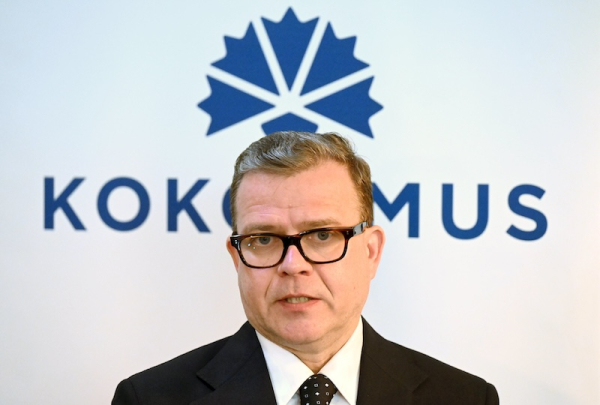


Chair of the National Coalition Party, Prime Minister Petteri Orpo. LEHTIKUVA
- Next Article Finland and Estonia begin automatic exchange of death records
A new economic analysis claims that the Finnish government’s current fiscal tightening programme is weakening economic growth and raising the country’s debt-to-GDP ratio.
The report, published by the Centre for New Economic Thinking (UTAK), focuses on the consolidation policies of Prime Minister Petteri Orpo’s administration. It concludes that the austerity-driven economic strategy is not achieving the intended goal of debt reduction.
The report was written by Lauri Holappa, Executive Director at UTAK, Otto Kyyrönen, Chief Economist at the Finnish Federation for Social Affairs and Health (SOSTE), and Patrizio Lainà, Chief Economist at the Finnish Confederation of Professionals (STTK). Their analysis uses a model based on the European Commission’s debt sustainability framework, as adapted by the Brussels-based think tank Bruegel.
“Our findings show that the government’s consolidation measures strongly suppress domestic demand,” Kyyrönen said. “It’s been clear all along that austerity is harmful for growth, but our simulations also demonstrate that the public debt ratio increases as a result.”
The report’s simulations incorporate fiscal multipliers from existing research into the Commission’s sustainability analysis. According to the authors, the estimates used in the modelling were conservative.
“Even with cautious assumptions, the conclusion is clear. Public finances would be in a better state without these harsh cuts,” Lainà said.
The authors recommend overhauling both Finnish and EU-level fiscal rules. They argue that investment spending should be excluded from deficit targets to allow for growth-enhancing public investment.
“We propose a €4 billion stimulus programme,” Holappa said. “It would include infrastructure and housing investments, increased education funding, capital support for growth companies, and industrial policy actions aligned with the green transition.”
According to the report, Finland’s current budget policy fails to account for the broader economic consequences of cuts, which may reduce revenues and increase welfare costs. The proposed growth package, in contrast, would seek to stimulate private sector activity and improve long-term sustainability through structural investment.
The government’s consolidation strategy has faced repeated criticism from labour organisations and social advocacy groups. The Finance Ministry has defended the programme, citing the need to address structural imbalances and control rising expenditure.
UTAK’s report adds to a growing body of analysis suggesting that austerity measures imposed during periods of economic uncertainty may prove counterproductive. The authors argue that a more flexible policy framework would give governments better tools to support recovery and structural adjustment simultaneously.
HT
- Next Article Finland and Estonia begin automatic exchange of death records
Source: www.helsinkitimes.fi
