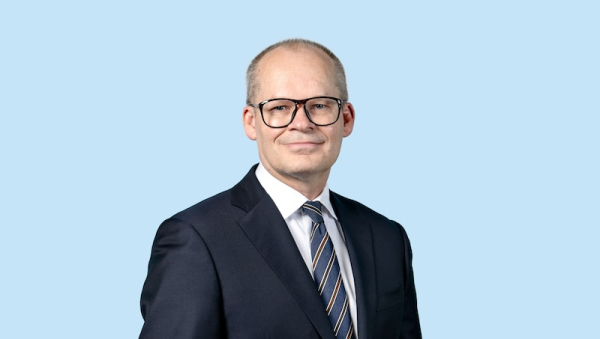


State Secretary to Finland’s Foreign Minister and Defence Minister Pasi Rajala. Photo: Finnish Government
- Next Article Orpo says Hungary and Slovakia must support Russia sanctions
Pasi Rajala, State Secretary to Finland’s Foreign Minister and Defence Minister, confirmed that Finland does not support freezing the EU’s association agreement with Israel.
Rajala represented Finland at last week’s EU Foreign Affairs Council, where member states formally discussed sanctions against Israel for the first time. He responded to questions from Yle on behalf of Foreign Minister Elina Valtonen, who declined an interview.
The Council discussed EU-Israel relations amid mounting pressure to respond to the situation in Gaza. Over 20 EU states, including Finland, have jointly called for an end to the fighting.
Recent reports have alleged Israeli forces killed civilians seeking food aid in Gaza. The humanitarian situation has prompted condemnation across EU capitals.
In a statement to BBC, Valtonen said: “If this is not a war crime, I don’t know what is.”
Despite such statements, Finland does not currently back freezing the association agreement, which grants Israel trade and research benefits in exchange for adherence to international human rights standards.
“Most EU countries support continuing dialogue with Israel. Lasting solutions that ensure both Israeli and Palestinian rights and security require diplomacy and political negotiation,” Rajala said in a written response to Yle.
The agreement is considered strategically important for Israel. The EU is its largest trading partner, and the agreement allows Israel tariff-free access to European markets and eligibility for joint EU projects.
Rajala said Finland remains open to reviewing the human rights clause in the agreement but confirmed that the Council made no decisions on the matter last week.
He added that Finland supports extending sanctions to violent Israeli settlers and is also open to the Swedish proposal to apply sanctions at ministerial level.
“Finland supports the idea of targeting violent actors, including ministers, but EU-wide consensus on such measures has not been achieved,” he said.
The EU’s foreign policy decisions require unanimity, which has so far blocked efforts to escalate measures. According to diplomats, divisions within the EU reflect broader political sensitivities among member states.
Finland’s own government is also divided on Israel policy. While members of the National Coalition Party and the Swedish People’s Party show sympathy towards recognising Palestinian statehood, the Christian Democrats and Finns Party oppose such steps.
The internal division has led to cautious public messaging. Valtonen has not taken a clear position on tightening the EU-Israel agreement and avoided a direct answer when asked by STT.
By contrast, Rajala’s comments mark a slightly more direct approach from the Finnish side.
He also stressed that all decisions on sanctions are made collectively at EU level. “Finland adjusts its policy according to joint EU decisions,” he said.
The association agreement has faced criticism from human rights groups, who argue that Israel is in breach of its human rights obligations under the pact.
Several EU lawmakers have called for its suspension following Israel’s military actions in Gaza and restrictions on humanitarian access.
Talks between the EU and Israel have continued regarding aid deliveries. Rajala acknowledged the urgency: “It is essential that aid actually reaches Gaza. The humanitarian situation is completely unsustainable.”
The EU has repeatedly called for unrestricted humanitarian access and condemned actions that obstruct relief efforts.
Rajala took up his current post in spring 2024 after serving at Finland’s embassy in Washington. He advises both Valtonen and Defence Minister Antti Häkkänen, playing a key role in foreign policy coordination.
His remarks underline Finland’s cautious stance in a politically sensitive EU debate. While opposing a freeze of the agreement, the government has not ruled out supporting further targeted measures.
For now, Finland continues to seek a balance between diplomatic engagement and supporting accountability in the region, aligned with EU decision-making.
HT
- Next Article Orpo says Hungary and Slovakia must support Russia sanctions
Source: www.helsinkitimes.fi
