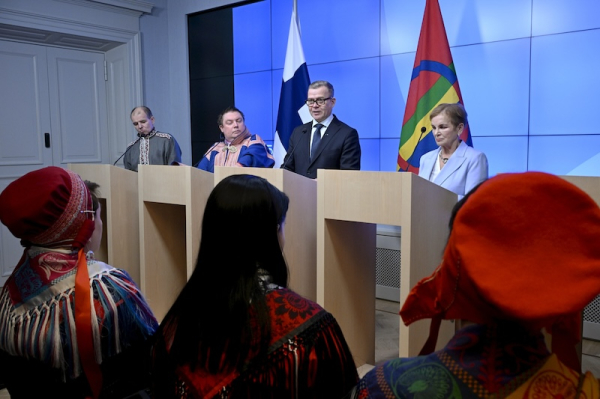


Skolt Saami Elder Veikko Feodoroff (L), acting president of the Sami Parliament Tuomas Aslak Juuso, Finnish Prime Minister Petteri Orpo and chairman of the Commission Hannele Pokka attend a press conference in Helsinki, Finland, on December 4, 2025. Photo: Markku Ulander / Lehtikuva
- Next Article Student detained after police operation at Vihti school
Prime Minister Petteri Orpo said Finland must issue a formal state apology to the Sámi people, following the publication of a truth and reconciliation commission report that documents decades of forced assimilation and systemic discrimination.
The final report, delivered to the government on Thursday, outlines historical injustices against the Sámi, including language suppression, cultural marginalisation, and displacement from traditional lands. The report is based on testimony from around 400 Sámi individuals and includes 68 proposed measures for repairing the harm.
“The state should apologise,” Orpo said. “But the apology must be broad and dignified. A parliamentary group with representation from all parties will determine how and when this is done.”
The Truth and Reconciliation Commission on Sámi Issues was established in 2021 during the government of Sanna Marin, with support from the Sámi Parliament and Skolt village council. It was tasked with identifying the extent of past and present injustices.
The commission’s chair, Hannele Pokka, said the boarding school system had served as a key tool of assimilation. Children were separated from their families, punished for speaking Sámi languages, and taught only Finnish values. Many lost their mother tongues and cultural identity. “These traumas persist,” she said.
The report describes how assimilation policies have disrupted Sámi language transmission and undermined traditional practices such as reindeer herding and river fishing. It notes the lasting role of churches and revivalist movements in reinforcing state-led cultural erasure.
Other contributing pressures include logging, mining, tourism, and military exercises in Sámi homeland areas. The report also raises concerns over declining salmon stocks in the River Teno, a factor that threatens the viability of the traditional Sámi culture along the river.
One section criticises the government for failing to consult Sámi representatives during Finland’s accession to NATO and negotiations over the Defence Cooperation Agreement (DCA) with the United States.
The commission recommends changes to legislation and governance. These include a dedicated Sámi affairs unit within the Prime Minister’s Office, led by a Sámi state secretary, and the formal adoption of international and Nordic agreements recognising indigenous rights. The report also proposes specific laws for Sámi reindeer herding and fishing rights.
The government has yet to commit to any timeline for implementing the recommendations. Orpo said the proposals would be reviewed by a parliamentary group headed by former Prime Minister Antti Rinne, who has been appointed secretary-general for the follow-up process.
Skolt Sámi spokesperson Veikko Feodoroff criticised the group’s formation, saying it was created without consulting Sámi institutions. Orpo defended the group’s legitimacy, stating that Sámi representatives would be included in broader cooperation efforts.
The commission praised the recent reform of the Sámi Parliament Act, approved in June, which strengthens Sámi self-governance in matters affecting their communities. It also recommended that the government present a report once per electoral term on the state of Sámi rights in Finland.
HT
- Next Article Student detained after police operation at Vihti school
Source: www.helsinkitimes.fi
