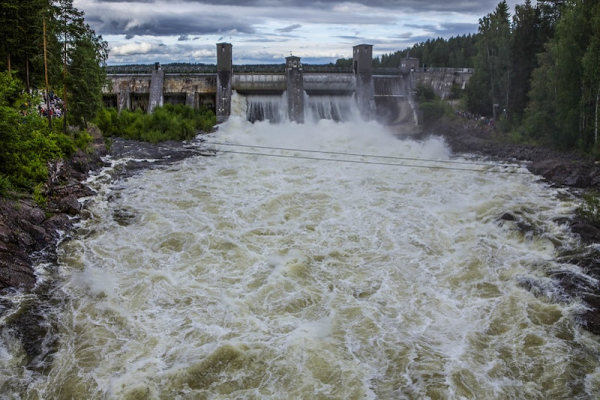


Vuoksi River, Hydroelectric plant at Imatrankoski, Imatra, Finland. Photo: Ninara via Flickr
- Next Article Gas canisters caused fatal van blast in Joroinen, say police
Russia has formally withdrawn from a 1972 bilateral treaty with Finland, which obligated it to deliver compensation electricity due to the impact of hydropower regulation along the Vuoksi River. The announcement, reported by Russian state media Tass and posted on the Russian government’s legal portal, marks another symbolic rupture in Finnish-Russian energy ties following the collapse of trade after the invasion of Ukraine.
The matter was first reported in Finland by Iltalehti.
The agreement, originally signed between Finland and the Soviet Union, was designed to offset energy losses incurred at Finland’s Imatra and Tainionkoski hydropower plants due to upstream regulation by Russia’s Svetogorsk power station. In practical terms, Russia supplied electricity to Finland to compensate for the diminished generating capacity caused by water-level changes.
The Russian government claims the decision to terminate the agreement is due to Finland’s refusal to continue purchasing Russian electricity. According to the state news agency Tass, Prime Minister Mikhail Mishustin instructed the foreign ministry to notify Helsinki that Russia is no longer bound by the treaty. The official decision was signed on 1 November.
Russia stopped delivering electricity to Finland in May 2022, shortly after its full-scale invasion of Ukraine. At the time, around 10 percent of Finland’s electricity imports came from Russia.
The treaty, signed on 12 July 1972 in Helsinki, included provisions that acknowledged the impact of water regulation on Finnish hydropower efficiency. Articles 3 and 4 of the agreement specifically addressed the mechanisms of energy compensation. Russia’s legal directive now terminates these provisions unilaterally.
In Finland, the hydropower stations affected by the treaty are key installations on the Vuoksi River in the southeastern region. The Imatra station, completed in 1929, remains the country’s largest hydroelectric facility. The Svetogorsk plant lies just across the border in Russia’s Leningrad Region.
The cancellation of the agreement is mostly symbolic in practical terms, given that no electricity has flowed under its terms for over three years. Still, it marks another step in the systematic dismantling of post-war bilateral agreements between Russia and its former Cold War neighbours.
Russia’s statement asserts that the energy treaty is void due to what it calls Finland’s “unilateral” refusal to engage in electricity trade. Finnish electricity operators stopped importing Russian energy following the European Union’s sanctions and the deterioration of security ties with Moscow.
HT
- Next Article Gas canisters caused fatal van blast in Joroinen, say police
Source: www.helsinkitimes.fi
